


.comment-link {margin-left:.6em;}

Ask the Pastor

† Theological musings and answers to selected questions by a confessional Lutheran pastor.


25 December 2012

A Truly Meaningful Christmas

Reposted from 25 December 2007

Betty Boop ChristmasComplaints about people not knowing “the true meaning of Christmas” started this year in mid-October, as the first holiday advertising began. Most Christians complain at least a bit about commercialism obscuring or obliterating a godly celebration of our Savior’s birth. We’re joined by many non-believers who likewise deplore the money-first mentality of the season’s advertising.

While there’s certainly plenty of blame to go around, we who claim to be Christian cannot accuse others without at least partially accusing ourselves. After all, don’t we already know about “the true meaning of Christmas”? Most of us can tell the story, many able to recite it word-for-word from our old King James Bibles.

Unfortunately, knowing the true meaning of Christmas doesn’t guarantee our celebrating a truly meaningful Christmas. In all of life, Christians too often experience disconnects between what we know and what we do. So it is with the Feast of the Nativity. We remember the angel’s words, “Unto you is born this day in the city of David a Savior, who is Christ the Lord. (Luke 2:11)” Then we forget why we need this Savior.

The Christmas hymn Hark the Glad Sound first announces His coming, then invites our response: “Let every heart prepare a throne And every voice a song.” The next stanzas tell how He brought salvation from “Satan’s bondage” and our own sinful actions. They sing of Christ rescuing mankind from the effects of sin, including mental defect and illness, blindness, fiscal and spiritual poverty, heartbreak, and the like. We know that in time, we receive these only in part; however, we are certain that we’ll enjoy them fully in the Resurrection.

The true meaning of Christmas certainly includes the fullness of Jesus’ life, work, suffering, death, and resurrection. “Christ Jesus came into the world to save sinners (1 Timothy 1:15)” and no amount of commercial or sentimental excess can change this fact. The Christ Child came not to market violent electronic games, expensive new cars, or other consumer items. Likewise, His virgin mother “laid him in a manger (Luke 2:7)” not to invite our cooing over the cute Baby but simply to give Him a place to rest His newborn, helpless body as He entered the world to which His Father sent Him as Savior.
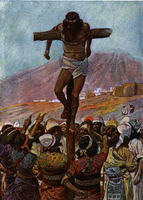
Jesus CrucifiedHow could any true Christian peer into Jesus’ first bed without also seeing cross and tomb? At the beginning of His life of humble service, Mary “laid him in a manger.” After He died, Joseph of Arimathea and Nicodemus took Him to “a new tomb” in a garden and “laid Jesus there. (John 19:41-42)” The almighty Son of God began and ended His saving work unable to bed Himself. He depended upon others to lay Him to rest after He drew His first breath and once He drew His last. He willingly “made himself nothing” and “humbled himself by becoming obedient to the point of ... death on a cross. (Philippians 2:7-8)” We understand the true meaning of Christmas when we realize that everything Jesus Christ did, He did to save us from our sins.

Unfortunately, we often get stuck between knowing the true meaning of Christmas and converting that knowledge into a Christmas that’s truly meaningful. When we become caught up in buying and exchanging gifts, we forget that true gifts aren’t exchanged — they’re given. Indeed, if you expect something of equal value in return, how can it be a gift? We can get tired and frustrated when we desire to focus on the holiday’s central meaning while still going along with so many of the world’s distractions. In this, we don’t differ from Saint Paul, who lamented, “I do not do the good I want, but the evil I do not want is what I keep on doing. (Romans 7:19)”

In A Christmas Carol, Ebenezer Scrooge was terrified into changing his outlook and actions. Dickens commented on the miser’s conversion: “It was always said of him, that he knew how to keep Christmas well, if any man alive possessed the knowledge.” He then expressed the wish, “May that be truly said of us, and all of us!” Dickens may have gotten some of the actions right — “Love is the fulfilling of the Law (Romans 13:10)” — yet nowhere recognizes that permanent change comes not from within but without. Scrooge’s change was wrought by fear, and fear is a tool of God’s Law.

If we were able to keep the Law, we’d have no need for our Savior. However, we can no more truly and fully “keep Christmas well” than can we “listen to the voice of the Lord ... do that which is right in his eyes, and give ear to his commandments and keep all his statutes. (Exodus 15:26)” Christ kept the Law perfectly, fulfilling its demands of which we were incapable. We can’t make ourselves into “better” Christians any more than we can make ourselves into Christians in the first place. The ability and the glory belong to “God who works in you, both to will and to work for his good pleasure. (Philippians 2:13)”

Likewise, keeping Christmas cannot happen because we hate our own actions or despise the world’s greed. Christ’s birthday celebration holds deeper meaning as we quit trying to “keep” or to “do” or to “change” and instead are kept by Him, changed by Him, and have His good done to us. Having a meaningful Christmas doesn’t necessarily mean singing in the Church choir, preaching the festive sermon, or placing a larger than usual offering in the plate — although each of these can be wonderful ways of celebrating the holiday’s meaning.

Christmas becomes meaningful when we quit trying to bend it into our own shapes and instead let it shape us. Instead of a time of demanding that God do what we desire, we ask Him to work His desires upon us. Having a meaningful Christmas means having the knowledge that nothing we can give God could ever match His Gift to us — all the while seeking new ways to offer our thanksgivings by offering ourselves to Him in thought, word, and deed.

A meaningful Christmas won’t be found in malls or online shopping sites. It will not come in a dream delivered by ghosts. Watching A Christmas Story, How the Grinch Stole Christmas, or A Charlie Brown Christmas aren’t the right answers, either — although Linus’ recitation of the Christmas Gospel to Charlie Brown (see video below) points us in the right direction. Not even at home, gathering around decorated tree or blazing fire, do we usually find a completely meaningful Christmas.
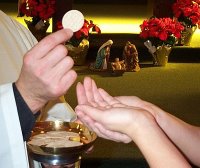
Christ MassA meaningful Christmas comes when we recognize that God gives us every good gift, including meaningful lives. It comes from the pure preaching of the Gospel Word and the proper use of the sacraments. It comes where and when it pleases the Holy Spirit — and the Spirit is quite pleased to give us the goods in Christ’s Church. Meaning fades through“neglecting to meet together” in Christ’s Church rather than “encouraging one another (Hebrews 10:25)” in corporate worship.

Nothing has changed since apostolic times. Christ still intends for us to receive His gifts in corporate worship. We find a meaningful Christmas as we continue devoting ourselves “to the apostles’ teaching and the fellowship, to the breaking of bread and the prayers. (Acts 2:42)” In the gathering of the saints, Baptism saves us “by the washing of regeneration and renewal of the Holy Spirit, whom he poured out on us richly. (Titus 3:5-6)” Hearing the Gospel, “the word of the cross” applies “the power of God (1 Corinthians 1:18)” that forgives and renews us. Holy Communion feeds us on our pilgrimage, restoring and enhancing meaning through the sealing of a new covenant relationship with God “for the forgiveness of sins. (Matthew 26:28)”

A truly meaningful Christmas comes not by what we say or do. It isn’t anything we can produce or purchase. It isn’t reckoned by the number and value of presents given or received. A truly meaningful Christmas happens only when we realize that without Christmas, none of life would have meaning.

“God bless us, every one!” Bless us with faith, with meaning, and with a fervent desire to give to others the Love that came down at Christmas.

Cross posted from Happenings.


Scripture quoted from The Holy Bible, English Standard Version™, © 2001 by Crossway Bibles.

Send email to Ask the Pastor.

Walter Snyder is a Lutheran pastor, conference speaker, author of the book What Do Lutherans Believe, and writer of numerous published devotions, prayers, and sermons.

Newspaper column #532

06 December 2012

The Real Saint Nick

The Commemoration of Nicholas of Myra

While many Christians give presents sometime during early winter, many avoid gift-giving on Christmas. Some wait until Epiphany on 6 January, since this day celebrates the Wise Men arriving in Bethlehem and giving their gifts of gold, frankincense, and myrrh to the Christ Child.

Nast's Santa
In much of Europe, children will receive presents this Thursday (6 December), which is Saint Nicholas Day. Stories about this Third Century pastor’s generosity gradually led to tales of his ongoing bringing of presents. Yet the Nicholas of history bears scant resemblance to the “jolly old elf” of Clement Moore’s poem or the chunky, red-clad image developed by Thomas Nast and expanded by Coca-Cola.

Actually, we know very little about the original St. Nick. A study of his remains indicates a man barely 5 feet tall who at one time suffered a broken nose. Whether broken as an adult or a child, we don’t know — although he seems to have had a rather combative nature, particularly when faced with an unrepentant heretic. Because Arius denied the full divinity of Jesus, Nicholas reportedly slapped him during a meeting of the Council of Nicaea.

The other bishops didn’t take this lightly and Nicholas’s violence dismayed even the most orthodox among them. Their strong rebuke included a threat to strip him of his bishopric but Nicholas quickly repented his action and remained in office.

Saint NicholasThe bringer of gifts obviously grew out of different stories. He seemingly came from a wealthy family. Desiring to serve God in physical poverty, he gave away his inherited fortune and gained renown for his generosity, especially toward the truly poor and needy. The stories say that he gave his contributions in secret whenever possible.

An apocryphal story tells of three sisters whose father wasted the family fortune. If a girl had no dowry, she had no way to marry into a respectable family. Normally, only slavery or prostitution would be such a woman’s means of support. When Nicholas about them, he sneaked up to the house and tossed sufficient dowry money through the sleeping family’s windows so that the girls could each wait for a proper marriage. Some versions have him wrapping coins (and jewels) in stockings — beginning a tradition of gifts in stockings.

PawnbrokerThe three bags of gold were later stylized into three golden balls, which passed into usage as the sign of pawnbrokers. Perhaps the connection is that those in dire financial straits often turn to such people in order to gain ready cash to tide them through their troubles. Because of this, when patron saints became popular, he became favored by pawnbrokers. Additionally, many sailors looked to him for help.

His patronage for children stemmed from another apocryphal story, one much less likely than that of the three sisters. In it, he raised three boys from the dead after they’d been murdered by an evil butcher and placed in a brine barrel to be cured and sold as ham. Perhaps the salty brine also led to the connection with sailors.

So if you’re tired of the commercialization of Christmas but still want to keep Santa in some way, or if you just want your presents three weeks sooner than everyone else, maybe you should look into celebrating St. Nicholas Day. And if you do pause to remember the saint, here’s a hymn verse I wrote for the commemoration:

   With joy Your Church remembers
   Saint Nicholas, the blest,
   Who gave up earthly treasures
   And Jesus’ name confessed.
   The poor and weak he welcomed,
   The heretic he scorned;
   Through faith and life and preaching,
   Christ’s Gospel he adorned.

Added note: For a bit more, including Lection and Collect, check this post from Aardvark Alley.

Send email to Ask the Pastor.

Walter Snyder is a Lutheran pastor, conference speaker, author of the book What Do Lutherans Believe, and writer of numerous published devotions, prayers, and sermons.

Article first appeared in The Concordian of 5 December AD 2012.

20 July 2012

A Family Tradition

or I’m Sure Jesus Done It This Way

Family Tradition
Hank Williams, Jr. had a huge hit in 1979 with the song Family Tradition. In it, he defended his hard-living, hard-drinking lifestyle against country music purists who wondered why he didn’t act more like they did. His response was that his behavior was just a “family tradition,” a statement that has some merit, since Hank, Sr. also frequently was at odds with the status quo of his day.

The song can be expanded beyond the Williams family — rebellious, illegal, wrong-headed, and self-destructive behavior is also a family tradition of Adam and Eve’s entire family tree. It may be expressed in different ways, subtly by some and brazenly by others, but no one conceived and born of human parents is exempt from sinful attempts to uphold the initial rebellion of our first parents in Creation’s early days.

It’s a family tradition to think of ourselves too highly and to look to gain unfair advantage over others. Conversely, it’s also a family tradition to despair of ourselves, to think that we are utterly without worth and having no place in the world. Self-control is practiced most frequently when it involves self-interest.

This doesn’t mean that drinking, dancing, or enjoying ourselves are wrong in and of themselves. Neither are walking, talking, or a host of other activities. But sinful intent — often followed by sinful excess — can turn any good gift of God into a mockery and make any blessing into a curse.

Booze and Drugs
The entire tradition of the family of man, then, is a giant rebellion against God, usually accompanied by the misuse of His good gifts and normally at the expense of our brothers and sisters. Like the song says, some people “drink” (to excess) or “roll smoke” (even though marijuana is illegal for most people in most parts of the country). However, even if we abstain from these, all of us find ways to “live out the songs” that we write for ourselves by envisioning a sinful narrative for our lives and then acting it out.

Thank God that He has another “family tradition” — that of showing grace and mercy to undeserving, rebellious sinners for the sake of His holy and perfect Son Jesus. In the divine Family, the Son perfectly follows the Father’s lead. He accepted the burden of flesh carried by Adam’s family but lived His life according to His Father’s will.

Jesus broke our human tradition of breaking God’s commandments. He enjoyed the gifts of Creation in moderation, treated others with kindness, acceptance, and forgiveness, and never rebelled, no matter what the Father asked Him to do. Even taking our sins upon Himself, suffering the consequences for His human family’s rebellion, and dying on the cross He did willingly and “for the joy that was set before him. (Hebrews 12:2)”

Jesus' Crucifixion
In faith, we are adopted out of our sinful family and made God’s children through Holy Baptism. Through the power of the Holy Spirit, God moves us to embrace new traditions of faith toward Him and sincere, active, fervent love for our brothers and sisters. As we practice living and loving as Christ lived and loves, these new traditions become ever more deeply ingrained and we may find it increasingly easy to love our neighbor — even our enemy — as ourselves.

We won’t see the old, sinful traditions pass away until we depart this life, either in death or when our Lord returns. Yet Christians are already allowed to practice the new traditions of our perfect family that will remain with us through the Resurrection of the Dead and into life everlasting.

Scripture quoted from The Holy Bible, English Standard Version®, © 2001 by Crossway Bibles.

Send email to Ask the Pastor.

Walter Snyder is a Lutheran pastor, conference speaker, author of the book What Do Lutherans Believe, and writer of numerous published devotions, prayers, and sermons.

Tags: | | | | | | | | | | | | | | | | | |

Based on my article from The Concordian of 18 July AD 2012.

16 May 2012

Ascension RSVP

Don’t Forfeit Your Banquet Invitation

Join the Banquet
What if you held a feast and no one came? Jesus dealt with this in the Parable of the Great Banquet (Luke 14:15-24). He told of a rich man who “invited many” but kept hearing excuses. Dismayed with the responses of his friends and acquaintances, the man had his servants invite “the poor and crippled and blind and lame” but there was “still room.” So he sent them out again to compel strangers to join the party and declared that no one who’d first declined would be able to attend.

In the Christian calendar, Ascension Day reminds me of the Great Banquet. Traditionally one of the major feast days, it celebrates our Lord returning to His Father on the fortieth day of Easter. This year, it falls on 17 May. Jesus ascended to His heavenly home because His earthly work was complete. He lived a perfect life and died an innocent victim in order to pay for mankind’s sins. He left that He might gift His disciples and the Church with the Holy Spirit. He also ascended so that He might “go to prepare a place for” believers (John 14:2).

After telling the Twelve why He would soon depart, He then said, “If I go and prepare a place for you, I will come again and will take you to myself, that where I am you may be also. (v. 3)” This promise is ours, also, and is why the Church so highly regarded the Feast of the Ascension. It was Jesus’ final earthly deed before He returns bodily to end the world, judge the nations, and bring the faithful to eternal life.

Our Host joyfully awaits the guests He has invited to the eternal feast, “the marriage supper of the Lamb. (Revelation 19:9)” We are not wealthy enough in righteousness and good works to merit an invitation. Instead, we are the spiritually “poor and crippled and blind and lame” who deserve nothing yet are promised all good things. He only asks us to trust His words and, with His blessing, to love others as He loves us as we live out our vocations.

Perhaps our inattention to the Ascension is a sign of the busy-ness of our lives. Our calendars are filled to overflowing and it seems difficult to carve out the time for worship on this one special Thursday each Spring. Perhaps we also downplay Ascension because it doesn’t have the cute Baby, sweet mother, shepherds, angels, and all the trappings of Christmas and because it lacks the deep valley and spectacular peak of Holy Week and Easter.

Ascension
However, Ascension Day may also slip by because we are too grounded in things earthly. Family and friends, business and agriculture, labor and leisure — these are all wonderful blessings from God. Yet they pale before the Father’s Gift of Jesus and the Son’s wonderful gifts of forgiveness, salvation, and life eternal. But we cannot see, taste, or touch them in the same manner as we do the people and things surrounding us and if we aren’t constant in the Word and attentive to His promises, these greater gifts become distant and less important to us.

Is it necessary that congregations hold special Ascension services? No.

If they do, is it imperative that we drop everything to attend? Of course not!

Paul wrote the Colossian Christians, “Therefore let no one pass judgment on you in questions of food and drink, or with regard to a festival or a new moon or a Sabbath. (2:16)” However, when holy days are regularly overlooked, it becomes much easier for us to forget the reasons why the celebrations first began.

Returning to the Parable of the Great Banquet, we see how easy it is for sinners to forget the enormity of the debt Christ paid, the fullness of His forgiveness, and the certainty of our salvation. When asked to stop our day-to-day tasks, to step away from things that provide brief earthly pleasure or diversion, and to specially prepare for a special day, we’re tempted to compose our own list of excuses. We might be pastors who don’t want to prepare an extra sermon and service. We could be parishioners who want to come home from work and relax, farmers who want to plant a few more acres, or parents who’ve already planned to drive our children to their regularly scheduled athletic activities. Each of us finds ways to say, “Sorry, Jesus, I’m a little to busy right now.”

I say this not to drive you to church but to invite you to always remember the Lamb’s Feast. We won’t fully participate until the Last Day dawns but already we have a foretaste as we gather to hear the Word and eat His Supper here on earth. Why celebrate Christ’s Ascension? Because it reminds us of — and guarantees to us — His return! For even as Paul challenged narrow, legalistic demands that all Christians worship at the same set times, He also reminded those same Colossians, “Set your minds on things that are above, not on things that are on earth. (3:2)”

Remembering the Feast of the Ascension, particularly attending church that day, is one way to turn our eyes away from things earthly, to “lay aside every weight, and sin which clings so closely” and to focus on “Jesus, the founder and perfecter of our faith, who for the joy that was set before him endured the cross, despising the shame, and is seated at the right hand of the throne of God. (Hebrews 12:1-2)”

I pray that whether at home or in the house of the Lord, you remember why He came, where He has gone, and whom He will invite to join Him in the never ending banquet He has established.

The line drawing is © 2004 by Ed Riojas and part of a collection available for purchase through the Higher Things Store.

Scripture quoted from The Holy Bible, English Standard Version®, © 2001 by Crossway Bibles.

Send email to Ask the Pastor.

Walter Snyder is a Lutheran pastor, conference speaker, author of the book What Do Lutherans Believe, and writer of numerous published devotions, prayers, and sermons.

Technorati Tags: | | | | | | | | | | | | | | | | | | | | | | | | | |

Based on my article from The Concordian of 16 May AD 2012.

28 December 2011

The Feast of the Holy Innocents

Christmas Joy Meets Satanic Slaughter

Nativity by van HonthorstThe ancient calendar followed by most of the Christian Church for almost two millennia intersperses beauty and awe with violence and death. Aside from Holy Week and Easter, this is nowhere more apparent than during the days of Christmastide.

Following the joyful celebration of our Savior’s nativity, the Second Day of Christmas commemorates Stephen, the Church’s first martyr, on the 26th. Saint John, the only apostle believed to have avoided a violent death, is remembered the next day. Through him, the Holy Spirit provides theological depth to the Gospels. John’s writings offer a treasury of understanding and living our lives as forgiven sinners, the promise of divine protection even in times of persecution, and the unshakeable, certain hope of our resurrection to eternal life.

The uplift of the Feast of Saint John dissolves into bloodshed on 28 December, the Fourth Day of Christmas. Holy Innocents Day marks the massacre of Bethlehem’s children by Herod the Great.

Holy Innocents English Stained GlassThe account of the Wise Men who traveled to find the King of the Jews (see Matthew 2:1-12) inflamed Herod’s jealousy. In response, he sent his soldiers to kill all of Bethlehem’s boys two years old and younger in order to protect his throne and lineage. This was one of the last major decisions Herod made in a life filled with vainglory and descending into bodily sickness and increasing madness.

Matthew 18:13-18 records what happened following the Wise Men’s visit. The evangelist concludes his account with a heartbreaking quote from the Old Testament: “A voice was heard in Ramah, weeping and loud lamentation, Rachel weeping for her children; she refused to be comforted, because they are no more. (v. 18; from Jeremiah 31:15)”

The slaughter of Bethlehem’s boys testifies to the world’s denial of God’s rule and its rejection of Christ’s Gospel of forgiveness. Fear drove Herod to do what he could to destroy Jesus. God rescued His Son but allowed the other young sons to be killed.

Holy Innocents by ReniSome try to use this massacre to accuse God of lovelessness. However, He intends it to strengthen our faith. The story of Christ’s Nativity may belong to the “milk” of Christian doctrine (cf. 1 Corinthians 3:2); the slaughter of the Innocents is certainly tough meat, a food for which we often still find ourselves “not yet ready.” Dining on the Word’s difficult passages fortifies us to face similar trials to those of Scripture’s saints. We learn that there is no “pain-free” Christianity anymore than there was a pain-free Christ. Though we are healed by Jesus’ wounds, devil and world remain eager to wound us anew.

Even though God allowed it to happen, He certainly took no pleasure in infanticide and bereavement, nor did He ignore the pain of the victims and their survivors. Callous disregard was Herod’s way, not God’s. We know how the Father’s heart was stricken because we see the depth of His Son’s woe at other times of spiritual or physical loss: Jesus cried over Mary and Martha’s loss of Lazarus (John 11:32-36) and wept for sinful Jerusalem (Luke 19:41-44).

Bethlehem lost her children because of God’s sympathy for our plight. They were part of the painful cost Christ accepted when He came to save us. He died not to keep these children from Herod but from Hell. He knew personally and intimately the pain felt by sword-pierced babies and grief-stricken parents. He carried it in His flesh and felt it fully as He hung from the cross.

The Holy Innocents by RiojasUntil this world ends, God will continue to use death, often savage and sometimes seemingly senseless, to open the gates of eternal life. Baptism is our participation in the death and resurrection of Jesus. Each saint’s death reminds us of the Savior’s death. Funereal sorrow gives way to supernal joy as we remember the One who died for us, since “to live is Christ, and to die is gain. (Philippians 1:21)”

May the Lord use the account of the Holy Innocents to lead us to sorrow over our sins and joy in His redemption. So we ask in the traditional prayer for this day: “Almighty God, the martyred innocents of Bethlehem showed forth Your praise not by speaking but by dying. Put to death in us all that is in conflict with Your will that our lives may bear witness to the faith we profess with our lips; through Lord Jesus, our Christ, who lives and reigns with You and the Holy Spirit, one God, now and forever.”

See related material at Cyberbrethren, Father Watson, and Aardvark Alley as well the archived posts on The Witness Days and The Days After Christmas here on Ask the Pastor.

Images of the paintings and the stained glass are in the public domain. The line drawing is © 2004 by Ed Riojas and part of a collection available for purchase through the Higher Things Store.

Scripture quoted from The Holy Bible, English Standard Version®, © 2001 by Crossway Bibles.

Send email to Ask the Pastor.

Walter Snyder is a Lutheran pastor, conference speaker, author of the book What Do Lutherans Believe, and writer of numerous published devotions, prayers, and sermons.

Technorati Tags: | | | | | | | | | | | | | | | | | | | | | | | | | | | | | | | |

Based on my article from The Concordian of 28 December AD 2011

23 October 2011

Help Me, Mr. Wizard!


Tooter Turtle and Mr. WizardMany of us who watched television as children in the early 1960s included King Leonardo and his Short Subjects (later renamed The King and Odie) in our Saturday morning schedule. One recurring segment involved Tooter Turtle, a young turtle living in the forest who wasn’t content with being a young turtle living in the forest. Because of this, he regularly (over 39 episodes) visited the lizard known as Mr. Wizard, asking him to change the time and place of his circumstances.

Tooter thought that going to another time and place would give him the opportunity to remake himself. In every episode, Mr. Wizard sent him off to new experiences, including working high iron, exploring the polar regions, flying a plane, and even riding with the U. S. Cavalry (which ended at Little Big Horn). The trouble was always the same: You can take the turtle out of the forest, but you can’t take the foolish thinking out of the turtle.

However, Tooter never suffered permanent consequences — at least not until his cartoon show was cancelled. Whenever a new endeavor collapsed and he was on the brink of absolute ruin or certain death, he would call out, “Help me, Mr. Wizard!”

Tooter TurtleAs soon he cried out for help, Mr. Wizard chanted, “Drizzle, drazzle, druzzle, drome; time for zis one to come home.” A swirling spell surrounded Tooter, who quickly reappeared in the lizard’s presence. After his return, Mr. Wizard gave him the same advice every time: “Be just vhat you is, not vhat you is not. Folks vhat do zis are ze happiest lot.”

Discontent with our own lives may lead us into like troubles. We may try to be someone we are not or do things for which we are unprepared. People reinvent their pasts and tell a story contrary to their personal histories. They become heroes when they were once participants, participants when they were once observers, or observers when they were once uninvolved.

Among our cultural stereotypes is the man facing a mid-life crisis. This movie and television plot staple feels trapped by a dead-end job or a marriage without the zest it once had. In milder settings, he makes foolish purchases of a motorcycle or a sports car or he starts dressing, talking, and acting like someone years younger. In more serious shows, he may have an affair or just walk out on his family, perhaps taking a new, younger wife. The reason this Hollywood stereotype abounds is that it’s built on actual events that happen all too often in the “real world.”

While aging white men are the customary on-screen culprits, no segment of society is without people desiring to be something — or someone — different and better from the way they perceive themselves. Yet, like Tooter Turtle, the fantasies they invent for themselves always seems to unravel, often with extreme consequences.

Paul in PrisonThis isn’t to say that we shouldn’t examine ourselves nor that we should be satisfied with our personal mediocrity. It means that we should pin our hopes for positive, real, and permanent change on something more than reinterpreted memories and wishful thinking. For example, the imprisoned Saint Paul wrote, “I have learned in whatever situation I am to be content. (Philippians 4:11)”

However, Paul’s contentment was with his station in life, not who he was by nature. For this same apostle could also complain about himself, “I know that nothing good dwells in me, that is, in my flesh.... Wretched man that I am! Who will deliver me from this body of death? (Romans 7:18, 24)”

Paul recognized that the Source of his contentment was also his Rescuer from discontent: Rather than inventing a new version of himself, he turned over his old, sinful self to God. Instead of chasing fantasies of what might have been, Paul focused on the reality of Christ crucified for his sins and raised for his justification (cf. Romans 4:23-25).

Paul realized that it wasn’t his circumstances, his friends, or his past that needed changing but rather his present, sinful self. He was certain that such a change didn’t come from within but from without, therefore, “Thanks be to God through Jesus Christ our Lord! (Romans 7:25)”

Rarely does God reach out and save us unscathed from the consequences of our fantasies of discontent. To do so might leave us thinking that we could continue to fall back into the same sinful desires with no lasting ill effect. However, he never abandons us. When we cry, “Help me, God,” He hears and responds by forgiving that which we have thought, said, and done. He may not stop the catastrophe but He always leads us through. We may carry scars in our flesh or in our memories but we also trust His words: “I will never leave you nor forsake you. (Hebrews 13:5)”

Psalm 51:10If we hear Him in time and take Him at His Word, we may never find ourselves hopeless at the edge of existence. When we realize that our root problem isn’t that we aren’t smart enough, heroic enough, or well-enough liked but that we are “brought forth in iniquity” and from conception tainted by sin (Psalm 51:5), God also teaches us that our problem isn’t fixed by reinventing ourselves but by being remade by Him. Only from the Lord do we receive “a right spirit” and “a clean heart (v. 10)”

Our rescue isn’t a cheap magic trick. There’s no Mr. Wizard or genii in a bottle to bail us out. The only salvation we have comes through brutally hard work and absolute adherence to the Word and the will of God. Yet it’s not our work or our faithfulness that saves but that of Christ. By the grace of God, through faith in Jesus, we receive the benefits of His perfect obedience and innocent suffering and death.

As God changes our condition, He continues to work on our persons. His discontent with our sinful natures leads Him not to banish us but to repair, restore, and redeem us. He blesses us with the same contentment Paul carried; that is, the peace of knowing that we’re in His care while He works through Word and Holy Spirit to recreate us in the divine image our first parents abandoned in Eden.

We remain works-in-progress as long as we remain on earth. Yet we know that our healing will be complete in the Resurrection. Finally, we will be free of all our sin-brought discontent when we stand before our Savior on the Last Day and hear His invitation to enter His Father’s eternal presence in purity and glory. This story has the real “happily ever after” ending that our broken spirits crave — an ending already guaranteed by our living, loving Lord Jesus Christ.

Scripture quoted from The Holy Bible, English Standard Version®, © 2001 by Crossway Bibles.

Send email to Ask the Pastor.

Walter Snyder is a Lutheran pastor, conference speaker, author of the book What Do Lutherans Believe, and writer of numerous published devotions, prayers, and sermons.

Technorati Tags: | | | | | | | | | | | | | | | | | |

Expanded from newspaper column of 19 October AD 2011

27 September 2011

Sexually Pleasuring Yourself

From the Archives

Q: Is masturbation a sin?

A: I receive this question with a fair degree of regularity. It’s true that the Bible does not specifically prohibit it. However, I believe that Scripture generally speaks against the thoughts and feelings involved in the action.

Tamar and JudahAmong Christians and many Jews, masturbation often is called “onanism,” after the sin of Onan, who would not fulfill his responsibility with Tamar, Judah’s daughter-in-law. His was only one of several transgressions committed by Judah’s family in Genesis 38 which the Lord needed to confront.

Technically, Onan wasn’t condemned for the act of masturbation per se, but for failure to act as husband in all aspects in completing the duties of his deceased brother for his sister-in-law. It appears that his actual, physical sin was premature withdrawal in order to avoid fathering a child. Verse 9 says, “Onan knew that the offspring would not be his. So whenever he went in to his brother’s wife he would waste the semen on the ground, so as not to give offspring to his brother.” In so doing, Onan experienced sexual pleasure without living up to the moral and familial obligations that sex entails.

We know that just because one feels guilty about a particular action doesn’t automatically make it wrong, since Satan would have us feel guilty about many guilt-free activities, thus burdening our consciences. Still, since masturbation normally accompanies lustful desires and erotic fantasies, it is best left alone. In other words, it may not be the action but is certainly the accompanying desire that is both sinful and hurtful to the one involved.

Jesus said, “Everyone who looks at a woman with lustful intent has already committed adultery with her in his heart. (Matthew 5:28)” This includes looking with our imaginations in the privacy of our own rooms. Therefore, the sins of lust, covetousness, and adultery can all be involved in masturbation, although it may not be true that all are involved every time.

Also, masturbation may become part of a pattern of psychological and spiritual addiction. Desire for self-gratification can outweigh a relationship with the Giver of all good things. It can lead one to avoid establishing and maintaining good relationships with others of the opposite sex. In short, while someone may argue that masturbation isn’t always wrong, you cannot convince me that it’s the most right thing to do.

I’m going to let Martin Luther have the final word here. In explaining the 6th Commandment, “You shall not commit adultery,” he wrote, “We should fear and love God that we may lead a chaste and decent life in words and deeds, and each love and honor his spouse. (Small Catechism)” I fail to see how masturbation and the accompanying imaginations of the heart are at all “chaste and decent.”

Meaning of the Sixth Commandment quoted from The Small Catechism by Martin Luther, a public domain text.

Scripture quoted from The Holy Bible, English Standard Version®, © 2001 by Crossway Bibles.

Send email to Ask the Pastor.

Walter Snyder is a Lutheran pastor, conference speaker, author of the book What Do Lutherans Believe, and writer of numerous published devotions, prayers, and sermons.

Technorati Tags: | | | | | | | | | | | | | | | | | | | | | | |

Expanded from newspaper column #143:3

19 September 2011

A Hug Is Just a Hug ... or Is It?


If a man allows himself to be hugged by his ex-girlfriend is he committing adultery?

Children HuggingNormally, I'd say no. However, if he finds himself still desiring her, then yes. Of course, the desire would probably be there before the hug. I think that most men and women probably hug at least one former boy- or girlfriend after they've started dating, become engaged to, or married someone else. The vast majority of these are, likely, completely innocent.

You should also ask yourself why you want the answer. If this is the man you’ve married or are otherwise committed to, has he ever given you occasion to doubt his sincerity and commitment to you? Or is this a bit of unfounded suspicion that could tear apart the relationship you now have?

Of course, there are times when even innocent-seeming actions are wrong. Jesus’ words are certainly true: “I say to you that everyone who looks at a woman with lustful intent has already committed adultery with her in his heart. (Matthew 5:28)” The same goes for hugging and any displays of affection or flirtatiousness. For example read what I wrote in Flirting with Disaster.

Bottom line: Unless you have good reason to doubt him, try investing the same energy you’re spending in questioning him — and more — in showing your love for him.

Scripture quoted from The Holy Bible, English Standard Version®, © 2001 by Crossway Bibles.

Send email to Ask the Pastor.

Walter Snyder is a Lutheran pastor, conference speaker, author of the book What Do Lutherans Believe, and writer of numerous published devotions, prayers, and sermons.

Technorati Tags: | | | | | | |

15 August 2011

Blessed Virgin Mary: Mother of God


Q: You refer to Mary as “God’s mother.” Is that the same as saying “Mother of God”?

TheotokosA: This question came in response to one of last week’s posts, Jesus Is Immanuel, concerning matters of Christmas and Epiphany, wherein I wrote, “Immanuel means that the Virgin conceived and bore a Son without human father; God assumed our flesh and joined Himself to mankind; a human woman became God’s mother.”

If Mary is not the “Mother of God,” then Christ is not true God and our faith is built upon a lie. Perhaps because of persistent anti-Roman Catholicism, particularly among American Lutherans and Protestants, many parts of the Church became uncomfortable referring to Mary by this title. However, if we are heirs of the true theology of Scripture, the early Church fathers, and the Reformation, we cannot abandon this teaching.

Calling the Blessed Virgin “Mother of God” doesn’t mean we worship Mary. It means that we are worshiping the God who chose such miraculous means to come into His Creation and deliver sinful mankind. However, thinking and speaking in such manner does fulfill the prophecy Mary uttered when visiting Elizabeth: “For behold, from now on all generations will call me blessed; for he who is mighty has done great things for me, and holy is his name. (Luke 1:48-49)” Notice how she herself distinguishes between the honor she receives and the total majesty of almighty God.

After centuries of common use, the Council of Ephesus (AD 431) officially sanctioned the title Theotokos (God-bearer) for the Virgin. Somewhat amazingly to our modern sensibilities, this council officially condemned another title, Christotokos (Christ-bearer). This wasn’t done to dishonor the Christ but to remove one possible way for heretics to point to a Christ who wasn’t truly and completely God and one with His Father.

During its formative days, the Lutheran Church carefully aligned itself with historic Biblical Christianity. Thus, regarding Mary, the Formula of Concord (1577) clearly states, “We believe, teach, and confess that Mary conceived and bore not a mere man and no more, but the true Son of God; therefore she also is rightly called and truly is the mother of God. (Epitome VIII:7)”

For more on her feast day, please see Saint Mary, Mother of God at Aardvark Alley.

Reposted from 2006.

Scripture quoted from The Holy Bible, English Standard Version™, © 2001 by Crossway Bibles.

Send email to Ask the Pastor.

Walter Snyder is a Lutheran pastor, conference speaker, author of the book What Do Lutherans Believe, and writer of numerous published devotions, prayers, and sermons.

03 August 2011

Remembering the Saints

Q: What are some of the reasons why we celebrate saints’ days?

Saints DepartedA: Scripture commends our remembering the lives of earlier believers. The writer of Hebrews cites examples in chapter 11. Chapter 12 concludes this catalog of faithfulness by saying, “Therefore, since we are surrounded by so great a cloud of witnesses, let us also lay aside every weight, and sin which clings so closely, and let us run with endurance the race that is set before us, looking to Jesus, the founder and perfecter of our faith, who for the joy that was set before him endured the cross, despising the shame, and is seated at the right hand of the throne of God. (vv. 1-2)”

When and how we remember them is a matter of Christian freedom; that we do so is a way by which the Lord both corrects and inspires His Church. The correction comes both when we compare our faithlessness to their faithfulness and when we remember that many of the great heroes of the Faith also committed grievous sins — just as do you and I. The inspiration and encouragement come as we see how God takes ordinary people and does extraordinary things through them.

Let’s use today’s commemoration as our example. The Lutheran Church — Missouri Synod chose this day, 3 August, to commemorate three faithful women, the “Myrrh Bearers” Joanna, Mary, and Salome. These, along with Mary Magdalene, are the first people the Bible names who came to Jesus’ tomb early on that Sunday morning following His crucifixion. It appears from Luke 24:10 that other women accompanied them, these are the only ones we know.

Easter morn isn’t the first time they appear in Scripture. Luke 8:1-3 mentions Mary Magdalene and Joanna among the women providing financial support to Jesus and the Twelve. Salome was mother of James and John, so she had a very early knowledge of His work and she, along with Mary the mother of James the younger, joined the mourners as the Lord hung on the cross.

None of them seem to have come to the tomb because they were feeling extraordinarily holy. Instead, they came for the same reason that so many others visit so many different graves: They’d lost someone for whom they deeply cared and they wanted to honor Him by completing His burial preparations that the Sabbath had interrupted. They were so caught up in sorrow that they didn’t realize they were acting as faithful children of God.

The Women at the TombTheir faithfulness to One they thought dead was rewarded in spectacular fashion. When they arrived at the sepulcher, tearfully wondering who they would find to move the stone from its mouth, angels greeted them with the wondrous message of the Resurrection. One angel charged them with telling the disciples, and the women “departed quickly from the tomb with fear and great joy, and ran to tell. (Matthew 28:8)”

So it was that the earliest witnesses of the empty tomb and the risen Savior weren’t Peter, James, or John. Instead, it was some of Jesus’ quiet followers who first discovered that death was undone.

In these women, we have a wonderful example of faithful living and an indication that God often chooses ordinary people in ordinary situations to carry out His will. These were holy, pious, God-fearing women but they likely didn’t see themselves as that. To themselves, they were probably just Joanna, Mary, and Salome, three women who loved Jesus because He first loved them.

We, also, are most likely to act in true, selfless faith when we are least conscious of how holy, pious, or God-fearing we might be. Instead, we do right because it’s the right thing to do and only later — maybe not until the Last Day, do we find out that our deeds were righteous and praised by the Lord.

Jesus taught this lesson when speaking about the judgment of the sheep and the goats, when the righteous ask Him, “Lord, when did we see you hungry and feed you, or thirsty and give you drink? And when did we see you a stranger and welcome you, or naked and clothe you? And when did we see you sick or in prison and visit you? (Matthew 25:37-39)” These three women — with Mary Magdalene and whomever else may have accompanied them — lived it out in their support of Jesus’ ministry, their visit to His tomb, and their fearful yet joyful return to Jerusalem with the news that He was alive and coming soon to be with them.

For suggested readings and a prayer for the day, please see Joanna, Mary, and Salome at Aardvark Alley.

Scripture quoted from The Holy Bible, English Standard Version®, © 2001 by Crossway Bibles.

Send email to Ask the Pastor.

Walter Snyder is a Lutheran pastor, conference speaker, author of the book What Do Lutherans Believe, and writer of numerous published devotions, prayers, and sermons.

Technorati Tags: | | | | | | | | | | | | | | | | | | | | | | | |

25 June 2011

The Presentation of the Augsburg Confession


As a Lutheran pastor and theologian, I continually receive questions about my church: Who are we, where do we come from, what do we believe? Since we Lutherans have a very special remembrance today, I thought this a good time to share a bit of our history and teaching.

Diet of AugsburgIn 1530, our Lutheran forefathers made public proclamation of a new summary of the ancient Scripture truth: Mankind is justified by God’s grace through faith in Christ Jesus. They set forth this notion in a religious document affirmed by secular rulers. Written by Philipp Melanchthon, approved by Martin Luther, and signed by princes, dukes, and other civil leaders, the Augsburg Confession was presented to Charles V, the Holy Roman Emperor, on 25 June AD 1530.

Some thirteen years of activity preceded this gathering. Many Lutherans (and a considerable number of non-Lutherans) date the beginning of the Lutheran Church to Martin Luther’s posting of the Ninety-five Theses on the Wittenberg church doors on 31 October 1517. However, when he did this, he considered himself a faithful son of the Roman Catholic Church. When ecclesiastical leaders resisted debate and discussion, defending doctrines and practices Luther considered Biblically indefensible, his efforts for reform increased and others began following his lead.

By the time the Charles declared a diet (an imperial assembly) in Augsburg and summoned German princes and free territories to explain themselves and their “new” religious convictions, almost ten years had passed since Luther had been excommunicated by Rome and subsequently declared an “outlaw” by the empire. His theological understanding had grown, his differences with Rome and its papacy sharpened, and few of his followers believed that the possibility of reconciliation existed.

Still, they came to Augsburg — or at least some of them did. Luther’s ruler, John “the Steadfast” of Saxony, forbad Luther to attend, fearing he would be arrested or killed outright. When Melanchthon sat down to compose a statement of belief for the Evangelicals (evangelical means “of the Gospel”), he based the document on the Torgau Articles, written by Luther with input from a number of other theologians.

Philipp MelanchthonAfter completing an early draft, he sent it to Luther, who made a few suggestions but approved of its overall content. Some of the other religious leaders added their ideas and “Master Philipp” put it all together into a statement of Evangelical belief, citing supporting Scriptures and quoting the Church fathers to show that what was written was no novelty but was fully supported and attested by Holy Writ and the orthodox theology of the ancient Church.

This wasn’t what the emperor wanted. He desired peace, unity, and an organized resistance against Islamic Turks who were invading Europe. Instead, a group of the empire’s foremost leaders, including some responsible for the election of emperors, affixed their names to a document claiming that much of what the emperor believed was wrong and stating that his church misunderstood, obscured, and misapplied much of the Gospel.

When the German leaders wanted to make a public reading of their articles of faith, Charles first denied them. He then shifted the venue into a small chapel where no spectators would hear. On 25 June 1530, Saxon chancellors Bruck and Beyer brought German and Latin copies of the document into the room. Although Charles objected, the German copy was read aloud, then both copies were given to him. He kept the Latin, giving the German to his chancellor, probably because he barely understood the language spoken by a large number of his subjects.

From this time forward, the Evangelicals (later to be known as Protestants and Lutherans) were clearly distinguishable. The leaders had made a confession — not that they had done wrong, but rather of what they believed to be right. Perhaps the 95 Theses had announced the beginning of the end for the medieval Church but it wasn’t until Augsburg, when rulers and theologians publicly clarified their ongoing and irreconcilable differences with Rome, that we see what we might term a distinct Lutheran Church.

As the Evangelical movement spread, the Augsburg Confession became a test of Evangelical fidelity and a sort of “constitution” for Lutheranism. In some ways, we might draw a parallel from American history, where the Declaration of Independence set in motion events which culminated in the United States Constitution and the federal republic it established.

After Holy Scripture, the Augsburg Confession is the heart of the Lutheran Church. Based on Luther’s writings and in accord with his teaching, it also bears the mark of the gentler, more refined Philipp Melanchthon. It never seeks to be combative but in simple language states exactly what the Evangelicals believed, which Scriptures supported their faith, what beliefs and practices of Rome they thought contrary to the Gospel, and in what areas there was already agreement.

Luther RoseThis “heart of Lutheranism” itself has a “heart” — the unmerited but full forgiveness of our sins won by Christ on the cross. The first three articles tell who God is, declare His wrath at sin, and proclaim the incarnation, suffering, death, and resurrection of Christ. In Article IV, we then learn how God fixes all that is wrong in us: “[We] teach that men cannot be justified before God by their own strength, merits, or works, but are freely justified for Christ’s sake, through faith, when they believe that they are received into favor, and that their sins are forgiven for Christ’s sake, who, by His death, has made satisfaction for our sins. This faith God imputes for righteousness in His sight. Romans 3 and 4.”

How does this salvation come to us? Article V says, “That we may obtain this faith, the Ministry of Teaching the Gospel and administering the Sacraments was instituted. For through the Word and Sacraments, as through instruments, the Holy Ghost is given, who works faith; where and when it pleases God, in them that hear the Gospel, to wit, that God, not for our own merits, but for Christ’s sake, justifies those who believe that they are received into grace for Christ’s sake.”

The Confession continues by defining the Church in terms of the Gospel, condemning anything that obscures the Gospel or devalues Christ and detailing changes implemented by the Evangelicals to correct doctrinal abuses. It invites the reader (particularly Charles V) to see for himself that the Evangelicals had not tossed out any babies with the dirty bath water, but had kept any and all practices, ceremonies, and teachings that were not contrary to the Gospel.

Other statements of belief, ranging from the ecumenical Christian creeds of earlier centuries to other Lutheran documents of the 1500s, joined the Augsburg Confession in Concordia, the Lutheran Book of Concord (Agreement), in 1580. Just as a handful of thoroughly convinced public leaders signed the Augsburg Confession, so a large number of rulers and town council members joined in the initial subscription to Concordia. Meanwhile, over 8000 pastors and theologians had already become subscribers to the Formula of Concord, the summary confessional document in Concordia.

To this day, in The Lutheran Church — Missouri Synod, every pastor, teacher, and congregation pledges wholehearted agreement with Holy Scripture and with the entire Book of Concord, including the Augsburg Confession. This follows the practice of solidly Lutheran bodies around the world.

LutherOf course, some always find disagreement with Biblical dogma and may try to weaken the force of a doctrinal statement in order to include a wider confessional range within its teaching. This happened with the Augsburg Confession. Philipp Melanchthon, as previously noted, was gentler and more conciliatory in nature than many of his contemporaries and wanted to expand Evangelicalism to include the followers of John Calvin and others and, perhaps, also extend olive branches to Rome. Furthermore, since he’d written the Augsburg Confession, he seemed to think of it as his own, a document he could change to suit circumstances rather than a fixed exposition of Lutheran theology.

Melanchthon developed several alternate texts, the most noted being the Variata of 1540. It so weakened communion theology that John Calvin could accept it in good conscience. Therefore, later confessional Lutherans learned to specify that their subscription was to the Unaltered Augsburg Confession (UAC), not to the Variata. That is why many Lutheran cornerstones here in the United States include the initials UAC, as an expression agreement with the document presented on 25 June 1530.

Those who call themselves “confessional Lutherans” continue subscribing (signing on) to its theology because they believe that the creeds and confessions of Concordia are true expositions of Holy Scripture. These do not supplant nor supplement God’s Word; they merely focus on particular teachings in an orderly fashion.

We sometimes speak of Scripture as the norma normans (ruling rule) — it defines and establishes all doctrine. The Augsburg Confession, as are the other creedal statements, is norma normata (ruled rule) — it draws its entire content from Scripture. In other words, Concordia “rules” in confessional Lutheranism because Holy Scripture “rules” the creeds and confessions.

Because of this, confessional Lutherans practice quia (because) and not quatenus (insofar as) subscription: We agree with the Lutheran Confessions because they agree with Scripture, not insofar as they agree. In other words, we don’t pick and choose which of Concordia’s doctrines we will uphold and which we will deny. Instead, we believe that since all of the theology of the Book of Concord is the theology of God’s Word, all of Concordia is suitable for the tasks of teaching the Church, reproving false doctrine, correcting behavior, and encouraging the saints.

Augsburg Confession quotes public domain from the Triglot Concordia of 1921 as found at The Book of Concord Online Edition.

Send email to Ask the Pastor.

Reposted with slight changes from 21 June 2006.

Walter Snyder is a Lutheran pastor, conference speaker, author of the book What Do Lutherans Believe, and writer of numerous published devotions, prayers, and sermons.

Technorati Tags: | | | | | | | | | | | | | | | |