


.comment-link {margin-left:.6em;}

Ask the Pastor

† Theological musings and answers to selected questions by a confessional Lutheran pastor.


15 August 2011

Blessed Virgin Mary: Mother of God


Q: You refer to Mary as “God’s mother.” Is that the same as saying “Mother of God”?
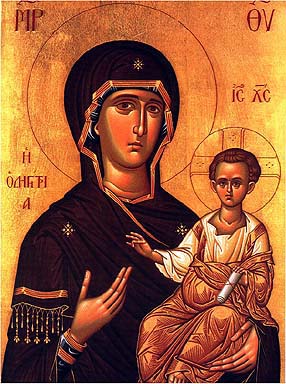
TheotokosA: This question came in response to one of last week’s posts, Jesus Is Immanuel, concerning matters of Christmas and Epiphany, wherein I wrote, “Immanuel means that the Virgin conceived and bore a Son without human father; God assumed our flesh and joined Himself to mankind; a human woman became God’s mother.”

If Mary is not the “Mother of God,” then Christ is not true God and our faith is built upon a lie. Perhaps because of persistent anti-Roman Catholicism, particularly among American Lutherans and Protestants, many parts of the Church became uncomfortable referring to Mary by this title. However, if we are heirs of the true theology of Scripture, the early Church fathers, and the Reformation, we cannot abandon this teaching.

Calling the Blessed Virgin “Mother of God” doesn’t mean we worship Mary. It means that we are worshiping the God who chose such miraculous means to come into His Creation and deliver sinful mankind. However, thinking and speaking in such manner does fulfill the prophecy Mary uttered when visiting Elizabeth: “For behold, from now on all generations will call me blessed; for he who is mighty has done great things for me, and holy is his name. (Luke 1:48-49)” Notice how she herself distinguishes between the honor she receives and the total majesty of almighty God.

After centuries of common use, the Council of Ephesus (AD 431) officially sanctioned the title Theotokos (God-bearer) for the Virgin. Somewhat amazingly to our modern sensibilities, this council officially condemned another title, Christotokos (Christ-bearer). This wasn’t done to dishonor the Christ but to remove one possible way for heretics to point to a Christ who wasn’t truly and completely God and one with His Father.

During its formative days, the Lutheran Church carefully aligned itself with historic Biblical Christianity. Thus, regarding Mary, the Formula of Concord (1577) clearly states, “We believe, teach, and confess that Mary conceived and bore not a mere man and no more, but the true Son of God; therefore she also is rightly called and truly is the mother of God. (Epitome VIII:7)”

For more on her feast day, please see Saint Mary, Mother of God at Aardvark Alley.

Reposted from 2006.

Scripture quoted from The Holy Bible, English Standard Version™, © 2001 by Crossway Bibles.

Send email to Ask the Pastor.

Walter Snyder is a Lutheran pastor, conference speaker, author of the book What Do Lutherans Believe, and writer of numerous published devotions, prayers, and sermons.

03 August 2011

Remembering the Saints

Q: What are some of the reasons why we celebrate saints’ days?

Saints DepartedA: Scripture commends our remembering the lives of earlier believers. The writer of Hebrews cites examples in chapter 11. Chapter 12 concludes this catalog of faithfulness by saying, “Therefore, since we are surrounded by so great a cloud of witnesses, let us also lay aside every weight, and sin which clings so closely, and let us run with endurance the race that is set before us, looking to Jesus, the founder and perfecter of our faith, who for the joy that was set before him endured the cross, despising the shame, and is seated at the right hand of the throne of God. (vv. 1-2)”

When and how we remember them is a matter of Christian freedom; that we do so is a way by which the Lord both corrects and inspires His Church. The correction comes both when we compare our faithlessness to their faithfulness and when we remember that many of the great heroes of the Faith also committed grievous sins — just as do you and I. The inspiration and encouragement come as we see how God takes ordinary people and does extraordinary things through them.

Let’s use today’s commemoration as our example. The Lutheran Church — Missouri Synod chose this day, 3 August, to commemorate three faithful women, the “Myrrh Bearers” Joanna, Mary, and Salome. These, along with Mary Magdalene, are the first people the Bible names who came to Jesus’ tomb early on that Sunday morning following His crucifixion. It appears from Luke 24:10 that other women accompanied them, these are the only ones we know.

Easter morn isn’t the first time they appear in Scripture. Luke 8:1-3 mentions Mary Magdalene and Joanna among the women providing financial support to Jesus and the Twelve. Salome was mother of James and John, so she had a very early knowledge of His work and she, along with Mary the mother of James the younger, joined the mourners as the Lord hung on the cross.

None of them seem to have come to the tomb because they were feeling extraordinarily holy. Instead, they came for the same reason that so many others visit so many different graves: They’d lost someone for whom they deeply cared and they wanted to honor Him by completing His burial preparations that the Sabbath had interrupted. They were so caught up in sorrow that they didn’t realize they were acting as faithful children of God.

The Women at the TombTheir faithfulness to One they thought dead was rewarded in spectacular fashion. When they arrived at the sepulcher, tearfully wondering who they would find to move the stone from its mouth, angels greeted them with the wondrous message of the Resurrection. One angel charged them with telling the disciples, and the women “departed quickly from the tomb with fear and great joy, and ran to tell. (Matthew 28:8)”

So it was that the earliest witnesses of the empty tomb and the risen Savior weren’t Peter, James, or John. Instead, it was some of Jesus’ quiet followers who first discovered that death was undone.

In these women, we have a wonderful example of faithful living and an indication that God often chooses ordinary people in ordinary situations to carry out His will. These were holy, pious, God-fearing women but they likely didn’t see themselves as that. To themselves, they were probably just Joanna, Mary, and Salome, three women who loved Jesus because He first loved them.

We, also, are most likely to act in true, selfless faith when we are least conscious of how holy, pious, or God-fearing we might be. Instead, we do right because it’s the right thing to do and only later — maybe not until the Last Day, do we find out that our deeds were righteous and praised by the Lord.

Jesus taught this lesson when speaking about the judgment of the sheep and the goats, when the righteous ask Him, “Lord, when did we see you hungry and feed you, or thirsty and give you drink? And when did we see you a stranger and welcome you, or naked and clothe you? And when did we see you sick or in prison and visit you? (Matthew 25:37-39)” These three women — with Mary Magdalene and whomever else may have accompanied them — lived it out in their support of Jesus’ ministry, their visit to His tomb, and their fearful yet joyful return to Jerusalem with the news that He was alive and coming soon to be with them.

For suggested readings and a prayer for the day, please see Joanna, Mary, and Salome at Aardvark Alley.

Scripture quoted from The Holy Bible, English Standard Version®, © 2001 by Crossway Bibles.

Send email to Ask the Pastor.

Walter Snyder is a Lutheran pastor, conference speaker, author of the book What Do Lutherans Believe, and writer of numerous published devotions, prayers, and sermons.

Technorati Tags: | | | | | | | | | | | | | | | | | | | | | | | |