










Stations of the Cross
Q: I’m curious about the “Stations of the Cross.” What are they and are they found in Scripture?
 A: The Stations of the Cross remember various stages of the Passion. Some Lutheran, Episcopal, and other churches set them up, although they are most used in Catholicism. I’ve seen several churches that have plaques or the like indoors, but they began as outdoor shrines, where one could “walk with the Savior,” stopping to think and pray at each.
 They are most usually arranged at intervals around the walls of a church nave. The traditional Stations trace a path known as the Via Dolorosa (Way of Sorrow) as Jesus was led out from Jerusalem to be crucified.
 The Stations may be of stone, wood, or metal, sculptured or carved, or they may be painted or engraved. Some are renowned art works, such as those in the cathedral in Antwerp, Belgium.
The construction and use of the Stations become common somewhere around the end of the seventeenth century and but they are now found in most Catholic churches.
 For some time, the number of Stations varied, but fourteen are now prescribed by Roman Catholic authority. As you read about them below, you see that some have Scriptural background, while others are derived from pious fable or myth.
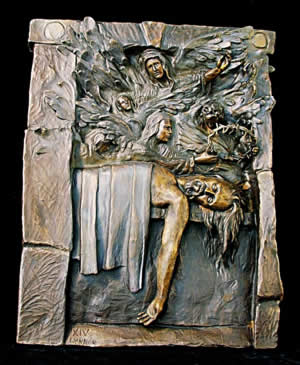
 The fourteen accepted by Rome are 1) Christ condemned to death; 2) the cross laid upon Him; 3) His first fall; 4) He meets His mother along the way; 5) Simon of Cyrene is forced to carry the cross; 6) Christ’s face is wiped by Veronica (the origin of the story of the veil that supposedly held the image of His face from that time forward); 7) His second fall; 8) He meets the women of Jerusalem; 9) His third fall; 10) Stripped of His garments; 11) His crucifixion; 12) His death on the cross; 13) His body taken down from the cross; and 14) laid in the tomb. In non-Roman Catholic versions, the multiple falls are usually omitted, as is the Veronica Station.
 A variant that doesn’t follow these exact steps originated in the Vienna area around the year 1800. Its eleven steps are 1) Agony in the Garden; 2) Betrayal by Judas; 3) Scourging; 4) Crowning with thorns; 5) Christ condemned to death; 6) Meeting Simon of Cyrene; 7) Women of Jerusalem; 8) Tasting the gall; 9) Nailed to the cross; 10) Death on the cross; and 11) His body taken down from the cross. Those uncomfortable with the Roman Catholic insertions of non-Scriptural Stations choose this latter variant or some other format that holds only Biblically attested events.
 I’ve seen some displays that work a Pietà (a portrayal of the dead Christ in His mother’s arms) into the station where He is removed from the cross.
A few other optional stations have also arisen. One shows the Savior’s agony in the Garden prior to His arrest. Another, gaining considerable popularity, concludes the Stations with the Resurrection.
 Indoor settings are normally permanently mounted for display and use as devotional aids. This is so for many outdoor Stations also, although some are only displayed during the Lenten season.
 The outdoor arrangement is becoming more common in many parts of the United States. Churches will set them on their lawns, in their parking lots, or elsewhere room permits, often including benches or other seating for those who wish to stop for a time to rest, contemplate, and pray at each Station.
 However the stations are displayed, they should not be considered as granting some special spiritual blessing; nor should hosting churches or individuals force visitors to the Stations pray or meditate according to any one set form.
Still, when used correctly by faithful Christians, the Stations of the Cross are a powerful and potentially edifying series of devotional settings.
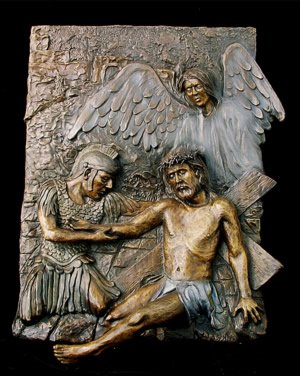 So how does one approach the Stations of the Cross? The simple answer is that Christians should come with faith grounded in the death and resurrection of Jesus as recorded in Holy Scripture.
 Beyond this, the believer should avoid seeking emotional stimulation. I don’t mean that we view the Stations as zombies. The visual power of the images coupled with the testimony of Scripture will, of course, trigger our emotions but placing emotionalism above edification certainly lessens their spiritual impact.
 To guard against this, it helps to approach the Stations after having recently read the Scriptural accounts of the Passion or following a sermon on Christ’s suffering and death. Take along prepared prayers, meditate on the Ten Commandments and your failure to keep them, pray the Our Father, and confess the Creed.
 Some people might want to travel the Stations by themselves. This can help them look honestly at their own sins without fearing the judgment of companions. However, others may find greater benefit in going with close friends or family. This allows them to comfort, pray with and for, and forgive each other. It also gives the individuals opportunity to confess their faith with like-minded people, perhaps encouraging them also to be more comfortable sharing their faith with unbelievers.
Obviously, Lent is the peak season for meditation upon the Stations of the Cross. Yet is there any time of the year when sin fails to oppress us, doubt assail us, or Satan confound us? If you find value in such contemplation during Lententide, you will during the rest of the year, as well.
Send email to Ask the Pastor.
Walter Snyder is a Lutheran pastor, conference speaker, author of the book What Do Lutherans Believe, and writer of numerous published devotions, prayers, and sermons.
Technorati Tags: Stations of the Cross | devotion | Passion | Via Dolorosa | crucifixion | Ask the Pastor | Pastor Walter P. Snyder | Walter Snyder
posted by Xrysostom | 20:43
|
1 comments


