.comment-link {margin-left:.6em;}

Ask the Pastor

† Theological musings and answers to selected questions by a confessional Lutheran pastor.


25 March 2009

Sermon: The Annunciation


Audio of tonight’s sermon on Hebrews 10:4-10, I Have Come to Do Your Will, is available at Happenings.

See Aardvark Alley for more on The Annunciation of Our Lord.

Technorati Tags: | | | | | | | | | | | | | | | | | | | | | | | | | | | | | | | | | | | | | | |

20 March 2009

Scriptural Veracity


Concluding the questions from our inquisitive cheerleader.

Q: We also wondered, should we seriously accept that Jonah was swallowed by a whale and that Noah built an ark that housed every animal? The host school’s theology teacher told us to take these with a grain of salt, saying that they could be parables or something comparable to a modern day political cartoon. But that Sunday our pastor told us that we should never underestimate the Bible and to take everything seriously. Help!

Whore of BabylonA: I firmly believe that when God wants us to take His Word figuratively, He clearly shows us that He’s using figurative language. When He says nothing, He expects literal interpretation. For example, most of Revelation is prophetic vision. I’ve yet to meet someone who’s waiting to see a literal “woman” riding on a literal “scarlet beast” having literal “seven heads and ten horns (17:3)” Instead, most people realize that this prostitute (17:1, 5, 15, 16; 19:2) is a symbol of Rome. The beast’s seven heads represent “seven mountains on which the woman is seated. (17:9)” For millennia, Rome has been called the City of Seven Hills, since it was founded upon these. She is “Babylon (v. 5)” because that was Scripture’s benchmark for powerful pagan empires.

Most people also understand the four horses and their riders in Revelation 6:1-7 symbolically. Yet with no Biblical injunction to switch their thinking, many grant interpret every number literally. Because of this, a large part of Christendom has no consistent application of Revelation. For example, many they insist upon a literal thousand year (earthly) reign of Christ (cf. 20:4) but also insist that while Satan is a fallen angel he’s not a literal “dragon” or “ancient serpent. (20:2)”

The teacher you mention is what I call an “à la carte theologian.” She follows modernist methodology, picking and choosing what to believe, and what to treat as myth, parable, or morality play. She probably speaks similarly about Creation’s completion over six literal days and likely denies the historicity of Adam and Eve, Job, and the Exodus. However, these are fables only if Jesus isn’t absolutely truthful and trustworthy. He validated the truth of Old Testament when He said, “The Scriptures ... bear witness about me. (John 5:39)” Just as in Revelation, unless He says otherwise, God demands literal interpretation of His Word.

Later Scriptures understand Noah’s Flood and Jonah’s great fish literally. Isaiah (Isaiah 54:9), Jesus (Matthew 24:36-39), and Peter (1 Peter 3:18-20) reference an historic Flood. Also, if Noah is the hero of a short work of fiction, what does that say about other Old Testament people and events listed in Hebrews 11? There we find Abel’s acceptable sacrifice, God’s covenant with Abraham, and Moses and the Exodus along with Noah constructing “an ark for the saving of his household. (v. 7)” As I compare Hebrews 11 with the rest of Scripture, I see no middle ground: All of these people and events are either historic or fictitious.

Likewise, Jesus didn’t talk about a Jonah myth but said, “Just as Jonah was three days and three nights in the belly of the great fish, so will the Son of Man be three days and three nights in the heart of the earth. (Matthew 12:40)” Later, He met another challenge from the Pharisees and Sadducees, saying that their “evil and adulterous generation” would receive no heavenly sign “except the sign of Jonah. (16:4)”

See also the 2007 post, Old Testament: Mythical or Literal and the links from it.

Scripture quoted from The Holy Bible, English Standard Version™, © 2001 by Crossway Bibles.

Send email to Ask the Pastor.

Walter Snyder is the pastor of Holy Cross Lutheran Church, Emma, Missouri and coauthor of the book What Do Lutherans Believe.

Technorati Tags: | | | | | | | | | | | | | | | | | | | | | | | | | | | | |

Expanded from newspaper column #572:2.

An Ending not Gay


The young lady in the previous post continues her questions:

Q: Do homosexuals go to heaven?

Gay ParadeA: Salvation comes by faith only to those who believe that their sins are completely forgiven because of Jesus Christ’s sacrificial death. Do your hypothetical homosexuals believe this? First of all, do they believe that homosexuality is actually a sin needing forgiveness?

Of course, we can include murderers, adulterers, oath-breakers, disobedient children, thieves, liars, and other sinners, asking, “Can anyone go to heaven?” Of course they can — but only by faith in Jesus Christ. Again, these people must recognize the sinfulness of their actions and know that intentionally persisting in sinful actions denies God’s grace in Christ.

However, when people reject Holy Scripture’s clear definition of sinful behavior, they cannot be saved, since they won’t admit that they have sinned. People try to redefine any number of sinful actions as good — or at least value neutral. Sexual sins, particularly homosexuality, are among the most common targets of such revisionism.

These revisionists use faulty reasoning, involving an incomplete understanding of love. Homosexual apologists basically claim that since God is love and since same-sex couples share love between themselves, their relationships must be fine, since they are built on love. However, erotic love, brotherly love, and friendship love all pale before the absolute, self-sacrificing love which is God’s by nature. Every other type of love must be constrained and guided by divine love.

The Lord is consistent: He condemns homosexuality in both the Old and the New Testaments. This obviously includes His judgment on Sodom. Twice in Leviticus, He says that it is “an abomination” for a man to “lie with a male as with a woman. (18:22; 20:13)” Attempted homosexual rape triggered Israel’s war against the tribe of Benjamin (see Judges 19-21). Baalism’s male cultic prostitutes often practiced homosexuality.

LesbianismIn the New Testament, aside from the general condemnations of sexual immorality, homosexuality is specifically mentioned. Romans 1 includes lesbianism (v. 26) and male homosexuality (v. 27) among the “dishonorable passions (v. 26)” that were divine judgment upon those who “exchanged the truth about God for a lie. (v. 25)”

Along with “the sexually immoral ... idolaters ... adulterers,” who “will not inherit the kingdom of God,” 1 Corinthians 6:9 includes “men who practice homosexuality.” Likewise, Paul wrote that “the law is ... laid down ... for the lawless and disobedient ... the ungodly and sinners ... the unholy and profane,” including “men who practice homosexuality” and “whatever else is contrary to strong doctrine. (1 Timothy 1:9-10)”

Furthermore, arguing only according to God’s love ignores the rest of His nature. Not only is His love perfect, so are His justice, holiness, and all His other attributes. He never stops being perfect and never ceases to demand perfect obedience from all Creation. He can’t stop hating sin; to do so is against His nature. If we attempt to redefine — or to justify through human reason or emotions — any sinful thoughts, words, or deeds as sinless, we compound our sin against Him.

The only lasting relief comes from facing, admitting, repenting, confessing, and receiving God’s forgiveness for our sins. Such true repentance involves a sincere desire to change our sinful way. Does change happen? It often does — yet our broken natures may weaken our resolve and drag us back into our old ways.

We thank God that such sins of weakness, committed less in defiance of His will than because of our human frailty, remain forgivable. Only when homosexuals — as well as thieves, liars, gossips, and others — reject God’s Law, self-justify their attitudes, and persist in their sinful actions do they remain unforgiven.

Previous columns addressed the related questions Homosexual from Birth? and Homosexuality: Inborn Sin or Genetic Code?

Scripture quoted from The Holy Bible, English Standard Version™, © 2001 by Crossway Bibles.

Send email to Ask the Pastor.

Walter Snyder is the pastor of Holy Cross Lutheran Church, Emma, Missouri and coauthor of the book What Do Lutherans Believe.

Technorati Tags: | | | | | | | | | | | | | | | | | | | | | | | | | | | | | | |

Expanded from newspaper column #572:1.

17 March 2009

The Cheerleader and the Pope

Grownup Questions from a Sixteen Year Old

Q: I just came back from my Luther League meeting where our advisor brought in a few of your articles. I was wondering if you could answer some of my questions that have been poorly explained.

One Friday night before a football game, my fellow cheerleaders were discussing the differences in religion. (We were in a Catholic school and were curious.) Mid-discussion, their theology teacher peeked out of a nearby room and asked if she could contribute to our conversation. Our views ranged from near-atheism to Missouri Synod Lutheran, Evangelical Lutheran, Mormon, Catholic, and United Church Of Christ. We wondered why Catholics put so much emphasis on Popes when we are there to worship God ... and many other things....


Cheer LeaderA: I think it’s fantastic that teens are having serious religious discussions. Of course, when you’re part of such a diverse religious gathering, you have to be careful to avoid letting discussion become arguing and then name-calling — or worse. I hope that as such opportunities present themselves to you, you grow ever more confident in the Faith and comfortable “speaking the truth in love. (Ephesians 4:15)”

Your cheerleaders provide a good summary of the whole world. Everyone has feelings and opinions that they hold tightly. Anyone with any sort of religious belief (or disbelief) considers certain teachings to be absolute truths. Some will allow that “your truth is valid for you while my truth is valid for me,” even if these “truths” flatly contradict one another. Others believe that there is only one “Capital T” Truth — and are absolutely convinced that contrary beliefs are erroneous, harmful, and quite possibly damnable.

I don’t know how long your conversation lasted, but you ladies covered quite a bit of theological ground in your pre-game warmup. I won’t go into any great detail on any of your topics but will try to highlight a bit about each. We’ll take care of the pope and church governance (or polity) this time. Next time, we can address your other questions, all of which more directly pertain to Biblical issues.

Flow ChartThe papacy grew because every organization needs ... organization! Somebody must keep order, ensure that necessary tasks are taken care of, and otherwise keep things running smoothly. The Christian Church hadn’t been around for very long when the believers realized that there had to be some sort of hierarchy or chain of command. Therefore, while all pastors were considered overseers of their individual congregations, certain pastors began to oversee other pastors in their region. In New Testament Greek, an overseer was called an episcopos. Pronunciation gradually changed as it moved to Latin (ebiscopus), Old English (bisceop), and finally to our later English word bishop.

Bishops of larger, more important communities gradually assumed more control and, in the minds of some, more importance. Since the center of government in Christianity’s early days was Rome, outlying congregations and their pastors and bishops looked more and more to the Bishop of Rome for guidance in spiritual matters. Over time, what started as a voluntary, bottom-up following became a top-down rule, instituted and enforced by religious leaders in Rome. After the empire became Christian, government joined the Bishop of Rome in enforcing Roman supremacy.

Of both religious and secular governments, very few have any degree of democratic process. There is, of itself, nothing wrong with having one person leading a large group of people — even in the Christian Church. However, if a leader strays from the truth of God’s Word, true Christians must first attempt to change the leader’s heart and mind and, if this fails, seek other leadership. In the mind of many Christians, there came a time when papal leadership was taking the Church in the wrong direction and reform became necessary.

Brother Martin LutherAs a Lutheran, you fully recognize the blessings of the Reformation and gratefully acknowledge the work of Martin Luther as part of this process. Remember, however, that Luther didn’t set out to leave Roman authority but to agitate for its reform and renewal. He never left Catholicism — they kicked him out because they disagreed with his conclusion: Luther ultimately believed that the papacy had ceased being a position of godly leadership and that the office had actually become Antichrist.

In the largest group of folks calling themselves Christian, where multi-millions of people around the world agree with most of what various popes say and do, it’s hard to find someone dedicated, strong, and courageous enough to pursue large-scale change. Therefore, the papacy will probably exist in some form until the end of time. Yet even while Lutherans believe that much of Catholic doctrine is wrong and that popes often mislead and wrongly teach the Roman Church, we don’t dare claim that all Catholics are ungodly, unchristian, Bible-ignoring sinners. For even if popes or other religious leaders in other church bodies get in its way at times, God’s Word still has the remarkable ability to create and sustain saving faith in its hearers.

And while we might rightly condemn popes for misapplying Scripture and misleading Christ’s Church, we must always remember that every other church body has also suffered false teachers and poor leadership. All too often, reform efforts graduated into extremism. Some Christian reformers led their followers into Gospel-denying, life-constricting legalism and established rules and regulations covering every aspect of living. Meanwhile, others went so far with the freedom of the Gospel that they began using it as an excuse to do anything their hearts desired — including all manner of sexual misbehavior.
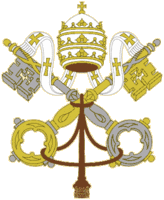
Vatican SealFinally, as you get to know individual Catholics better, you’ll discover that they hold a wide range of opinions about the papacy in general and the current pope in particular. Some barely pay any attention to him while others cling to his every word, treating him as the embodiment of Jesus Christ on earth. You might find some who actually “worship” him as fervently as they do our Lord.

However, many Catholics, even those who greatly respect and unswervingly follow papal leadership, still believe that their own works won’t merit heaven. Certain that Jesus is their Savior, they believe that only faith in Him saves them and hold that He — along with the Father and the Holy Spirit — are the only proper objects of their worship.

Next time, we’ll tackle more of what you asked.

Scripture quoted from The Holy Bible, English Standard Version™, © 2001 by Crossway Bibles.

Send email to Ask the Pastor.

Walter Snyder is the pastor of Holy Cross Lutheran Church, Emma, Missouri and coauthor of the book What Do Lutherans Believe.

Technorati Tags: | | | | | | | | | | | | | | | | | | | | | | | | | | | | | | |

Newspaper column #571