

.comment-link {margin-left:.6em;}

Ask the Pastor

† Theological musings and answers to selected questions by a confessional Lutheran pastor.


19 September 2007

Christians and Lawsuits


Q: A local Christian group to which I belong believes that it is unbiblical to take a Christian to court. I do not agree that it’s always wrong to do so. Christian avenues can be exhausted without a resolution and courts exist for a reason. Can you please give some clear guidelines with Scripture? They require my signature on a document and I’m not sure how to handle it.

Q: What steps should a Christian follow when taking another believer to court? What about when bringing someone from the world to judgment?

JudgeA: Please remember that I respond as a Christian pastor, not an attorney. Also, I am not appointed to judge between people (Christian or not). Rather, the Holy Spirit calls pastors to preach the Gospel, administer Christ’s sacraments, and to teach His Word in purity and truth.

Now regarding these questions, first of all, we hope that we never need to either sue or defend ourselves from civil suit. Not only does Scripture frown on such actions but we also know personally how legal action can often permanently divide people who were once friends. Saint Paul explicitly chastised the Corinthian Christians for their eagerness to drag brothers in the faith before civil magistrates — especially pagan judges such as Corinth had.

In 1 Corinthians 6:1-11, Paul reminds Christians that, beyond any current litigation, a Final Judgment awaits the world. Since, as he said, “the saints will judge the world, (v. 2)” why should we not also be able to judge among ourselves in “trivial cases”? In this passage the apostle leads believers to move away f rom actions against each other and into cooperation with each other.

When Christians act according to their faith in Jesus Christ, they will not break contracts, lie, cheat, withhold services, or do anything else that is civilly actionable. This applies equally in our dealings with other believers and with non-Christians. However, our sinful flesh still clings to us. As Paul wrote the Roman church: “I do not do the good I want, but the evil I do not want is what I keep on doing. (7:19)” We are no better than the apostle and we at times also commit such offenses.

ReconciliationThe Lord desires reconciliation and restitution among the saints to take place within the Church, not out in the world where the Faith is held up to public ridicule. Christians seek and promote justice, remembering that divine justice is tempered with mercy and love. It may be legally just that you receive recompense from one who has wronged you. However, it may not be merciful that you press your case through another’s extenuating circumstances, such as poor health, poverty, or the like.

Pursuing a case in a mean spirit is just as much a sin as is the original problem being judged. Indeed, when we carefully read 1 Corinthians 6:1-11, we see that if at all possible we should not sue other believers — even if we aren’t treated fairly: “To have lawsuits at all with one another is already a defeat for you. Why not rather suffer wrong? Why not rather be defrauded? (v. 7)” Why not, indeed? Yet such surrender of self, this refusal to stand up for our own “rights” often galls the wronged party.

Unless defending family or checking gross evil, it’s hard to justify suing anyone, Christian or not. Christ says in Matthew 5:38-41, “You have heard that it was said, ‘An eye for an eye and a tooth for a tooth.’ But I say to you, ‘Do not resist one who is evil.’ But if anyone strikes you on the right cheek, turn to him the other also. And if anyone would sue you and take your tunic, let him have your cloak as well. And if anyone forces you to go one mile, go with him two miles.”

Tread lightly when considering legal action. Seek to do the right thing for the right reasons. We Christians often find that our “turn the other cheek” talk is cheap when our own cheek is being struck. The world’s bumper sticker reads, “Don’t Get Mad, Get Even.” Meanwhile, Christians try to remember, “Don’t Get Mad or Even — Get Right with One Another.” This is sort of long to fit on a bumper sticker. It’s also quite cumbersome to fit into ourselves. Only Christ dwelling within us can enlarge and strengthen our hearts to where we can think and live in this manner.

Prodigal SonNow so far, we’ve mainly concerned ourselves with our actions when someone has done wrong to us. We still need to deal with our attitudes and actions when we sin against others. A believer motivated by Christ’s love wants to do the right thing. If I violate my word, speak harshly or evilly, or otherwise harm you, my desire should be to come running to make things right. If I wrong you and don’t offer either apology or recompense, I am guilty of an unrepented sin against you, and should face the judgment of the Church.

The Church should bring this same judgment equally to bear upon all believers who sin against each other and show no repentance. How this happens comes in large part from Christ’s words in Matthew 18:15-17. Most Christian churches list this passage as the central theme of their disciplinary policies: “If your brother sins against you, go and tell him his fault, between you and him alone. If he listens to you, you have gained your brother. But if he does not listen, take one or two others along with you, that every charge may be established by the evidence of two or three witnesses. If he refuses to listen to them, tell it to the church. And if he refuses to listen even to the church, let him be to you as a Gentile and a tax collector.”

In many churches, the pastor and the elders or deacons meet in turn with the two parties, hoping to bring their strained relationship to a satisfactory conclusion. Should their efforts fail, they may then bring the issue before the whole congregation. Depending upon one’s church affiliation, perhaps a council of ministers, a bishop, or others have the final say. Other churches place the final decision on a voters’ assembly or a board of deacons.

Remember that the Scriptures indicate that Christ established the pastoral ministry in order to forgive sins (John 20:21-23) and to bring reconciliation among people and between people and God (2 Corinthians 5:18). God’s Word also indicates that the pastors of congregations are the “overseers” (Acts 20:28) whom their flocks should “obey,” since “they are keeping watch over [the congregation’s] souls, as those who will have to give an account. (Hebrews 13:17)”

In matters of church discipline and unrepented sin, “exercising oversight” (1 Peter 5:2) means that a pastor must decide whether or not to allow either or of the parties to the altar. If he is forced to excommunicate someone, he must “tell it to the church,” informing the flock of the actions he’s sadly had to take. For more on this, please see Confession and Forgiveness by God through Man.

Of course, final actions should not be arbitrary but should follow after carefully weighing the evidence. In this method of resolution, Jesus gives opportunity for reconciliation at each step of the way. Still, Christ’s Church is bound by fidelity to Him to “purge the wicked person from [its midst]” (1 Corinthians 5:13) so as to prevent sin from spreading or leaving the impression that evil is sanctioned.

The first questioner still probably wonders about that signature the group wants. I cannot tell you whether to pick up your pen or to head for the door. Search the Scriptures, consider your conscience, reexamine the group, and only then decide if and how you will bind yourself to this organization’s rules.

Scripture quoted from The Holy Bible, English Standard Version™, © 2001 by Crossway Bibles.

Send email to Ask the Pastor.

Walter Snyder is the pastor of Holy Cross Lutheran Church, Emma, Missouri and coauthor of the book What Do Lutherans Believe.

Technorati Tags: | | | | | | | | | | | | | | | | | | | | | | | | | | | | | | | | | | | | |

12 September 2007

Lutheran Carnival


Thanks to The Moose Report for hosting Lutheran Carnival LXIII. Head up north to read some of the latest from the confessional Lutheran blogosphere.

Technorati Tags: | | | |

11 September 2007

Prayer Without Ceasing


Q: What does it mean to pray without ceasing? What does it look like and how should we develop it in our lives?

HandsA: Saint Paul wrote, “Rejoice always, pray without ceasing, give thanks in all circumstances; for this is the will of God in Christ Jesus for you. (1 Thessalonians 5:16-18)” Obviously it cannot mean hands folded and heads bowed through every waking moment. Nor can we unendingly “pray, lifting holy hands. (1 Timothy 2:8)” Either of these would interfere with us fulfilling our God-given vocations — and often make driving quite unsafe.

I think rather that the apostle provides the Holy Spirit’s two-fold desire for Christian prayer. First of all, our entire lives should submit to the Word and will of God. Years ago, I wrote in The Purpose of Prayer that prayer isn’t getting our way but rather being aligned with God’s way: “Prayer doesn’t change God’s mind — it changes ours, bending our wills to His perfect will.... God teaches us that He isn’t a vending machine wherein we pop in a petition and He drops our order into our hands.” Thus, part of prayer “without ceasing” means living with a reverent, submissive, and thankful attitude toward our heavenly Father, trusting that in all things, His will be done.

Secondly, I understand “without ceasing” as regularity of prayer. We don’t pray only when we have problems, when family members are sick or near death, or when we’ve exhausted all earthly helps. Instead, in good times and bad, Christians day by day seek to carry everything to God in prayer. Each day provides opportunities to ask for forgiveness, to intercede on behalf of others (including our enemies), to seek spiritual and earthly blessings for ourselves, to thank God for all He has done for us, and to simply praise Him “just because” He is God Almighty.

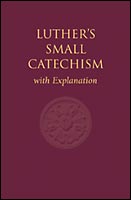
Small CatechismLived out, a life of prayer without ceasing could reflect the pattern expressed in the Lutheran Small Catechism. Here, each morning and evening, the Christian is encouraged to “make the sign of the holy cross and say: ‘In the name of the Father and of the Son and of the Holy Spirit. Amen.’ Then, kneeling or standing, repeat the Creed and the Lord’s Prayer.” We might also pray additional prayers at these times. Other prayers including the Lord’s Prayer, are encouraged at the beginning and end of our meals. However you schedule yourself, remember that God hears, encourages, and demands His children’s prayers.

Many hymnals and devotion books also provide frameworks for daily and weekly prayers. Some suggest special topics for each day, often based upon some Biblical event that happened on that same day. For instance, we might pray for a right reception of Holy Communion each Thursday, since our Lord instituted His Supper on that day. Our pattern may also be influenced by everyday life. For example, Monday suggests that we pray both for Godly labor and for the unemployed, since this is normally the day people return to work after their weekend rest.

Some years ago, The Lutheran Church — Missouri Synod (LCMS) put together this Guide for Daily Prayers in PDF format. It begins with a short set of suggestions for praying and day-by-day recommendations for prayer topics. Then follow four brief prayer and Scripture devotional services for morning, noon, early evening, and close of day. These may be used either by individuals or by groups in a combination of unison and responsive readings, such as a family gathered for a meal or just before bed.

Home AltarIf you have no other organized, systematic plan, this guide will certainly help you get started. And even if you’ve been praying for years, perhaps even gathering together around a family altar, you could travel far before discovering a more useful, practical took for maintaining focus in your prayer life.

Martin Luther suggest that we daily pray the Catechism. His intent wasn’t that we wade through the hundreds of pages in many modern printings of Lutheran, Catholic, and other catechisms, since these are filled with commentary, references, and supplemental material. Rather, he meant that we daily confess and ponder the central teachings of Christianity, particularly the Ten Commandments, the Creed, and the Our Father.

The Lutheran Small Catechism also leads us to pray about our lives as baptized believers, repentance and forgiveness of sins, proper preparation for receiving the Lord’s Supper. It includes brief orders for our daily prayers. The Scriptures involving in the Table of Duties involve various vocations and places in life and provide even more objects for our concern and subjects for our prayers.If you don’t own a catechism, you may download or print one in PDF. Other versions also are available; see the Small Catechism page at the Book of Concord site.

Praying HandsI also invite you to read Structure for Daily Prayer. Here I talked a bit about my own prayer life and also provided other resources and references for others to use.

Finally, ponder what the Holy Spirit says so well through Saint Paul: “First of all, then, I urge that supplications, prayers, intercessions, and thanksgivings be made for all people, for kings and all who are in high positions, that we may lead a peaceful and quiet life, godly and dignified in every way. This is good, and it is pleasing in the sight of God our Savior, who desires all people to be saved and to come to the knowledge of the truth.... I desire then that in every place the men should pray, lifting holy hands without anger or quarreling. (1 Timothy 2:1-4, 8)”

Daily prayer quote from Luther’s Small Catechism, © 1991 by Concordia Publishing House.

Scripture quoted from The Holy Bible, English Standard Version™, © 2001 by Crossway Bibles.

Send email to Ask the Pastor.

Walter Snyder is the pastor of Holy Cross Lutheran Church, Emma, Missouri and coauthor of the book What Do Lutherans Believe.

Technorati Tags: | | | | | | | | | | | | | | | | | | | | | | | | | | | | | | |

10 September 2007

Baptism and Saint Mary


Q: Was Mary, the mother of Jesus, baptized?

A: Scripture is completely silent on this topic. We have no idea if Saint Mary was baptized or, if so, when it might have occurred or by whose hand. I won’t even offer a guess, since there’s already too much idle speculation about the Blessed Virgin. A few examples include debates on Mary’s continuing virginity, her sinlessness at birth, how (or if) she died, and whether or not her body was carried to heaven to await the Last Day’s resurrection.

Send email to Ask the Pastor.

Walter Snyder is the pastor of Holy Cross Lutheran Church, Emma, Missouri and coauthor of the book What Do Lutherans Believe.

Technorati Tags: | | | | | | | | | | | | | | |

“Mixed Marriage” Between Christians


Q: Can a Baptist marry a Catholic and not be sinning under God?

Promise RingsA: Your question is valid also for Lutherans and for all other Christians desiring to marry other Christians who come from differing church backgrounds. We run into a bit of a problem, since the Scriptural warnings about differing confessions of faith between husband and wife don’t give us a lot of help with our questions. As for questions of interracial marriages, see the links at the end of this reply.

The Bible’s cautions and caveats generally address marriage between a believer and an unbeliever. On numerous occasions, the Israelites were warned against marriage to believers in Baal and other pagan deities. Similarly, New Testament admonitions follow the line the Lord set through Paul: “Do not be unequally yoked with unbelievers. For what partnership has righteousness with lawlessness? Or what fellowship has light with darkness? What accord has Christ with Belial? Or what portion does a believer share with an unbeliever? What agreement has the temple of God with idols? For we are the temple of the living God.... (1 Corinthians 6:14-16)”

God doesn’t bind Christian men and women to the specifics of one particular practice before allowing them to marry and blessing their union. However, differences in practice and in understanding the Faith can make a union difficult, providing stumbling blocks and temptations to sin, particularly if husband and wife both are strong believers.

I encourage a man or woman considering such a marriage to study the other’s beliefs carefully. Compare types of worship and church governance, differences between individual and congregational autonomy versus being led by a clergy hierarchy, and the role of pastors and priests. How does each person understand and accept infant baptism and baptismal regeneration? Is it truly His body and blood or only a spiritual presence of Christ in the Lord’s Supper? You can certainly come up with more topics.

Consider then these follow-up questions. Can he live without something that’s been a vital part of his life for years? Can she honestly worship in his church without feeling like a hypocrite? What would be most difficult to accept from the other’s church? What would be hardest to give up? Will Christ be and remain central in this marriage and how will they build their new lives around Him?

The couple should give prayerful consideration to the place of these various teachings and practices in their faith lives. Conversations with each one’s minister or priest could help clarify thinking and make it easier to arrive at a final solution. Indeed, even if a couple comes from the same church body — even from the same congregation — I urge that they go through a series of premarital counseling sessions with their own minister(s). The need becomes even greater when differences of faith and practice already exist.

Additional note: See Mixed-Race Marriages, Interracial Marriage, and Boaz, Ruth, and the Genealogy of Jesus for more Christian commentary on the racial and religious dimensions of “mixed marriage.”

Scripture quoted from The Holy Bible, English Standard Version™, © 2001 by Crossway Bibles.

Send email to Ask the Pastor.

Walter Snyder is the pastor of Holy Cross Lutheran Church, Emma, Missouri and coauthor of the book What Do Lutherans Believe.

Technorati Tags: | | | | | | | | | | | | | | | | | | | | | | | | | | | | | | | | |

01 September 2007

The Why and How of Home Altars


Q: Do you know anything about Lutherans or other post-Reformation Christians having “home altars”? I first discovered this idea in Bo Giertz’s The Hammer of God and recently read about them again. However, this is something I never hear about at all in current Lutheran circles. Has this practice fallen out of common usage? What would such “altars” look like and be used for? Usually we think of an altar in terms of corporate worship for celebrating the Eucharist, but this obviously would not be the use of this sort of structure.

A: I’ve also read and enjoyed The Hammer of God. And while Bishop Giertz mentioned them, home altars aren’t peculiar to Lutherans or even to Christians. Many Hindus, Buddhists, and others also have some sort of sacred place in their homes.

Icon StandI occasionally see remnants of the family altar in various homes, usually those of older pastors and laity. Some of them still utilize one of the out of print editions of F. W. Herzberger’s The Family Altar. As you note, the home altar isn’t designed for the Lord’s Supper. Still, it is a place around which people may gather in order to offer prayers. Such altars aren’t to be confused with votive altars or shrines. These latter are designed to honor and, quite often, to aid in prayers to the saints. While other bodies may also set up home altars, Lutheranism will be our focus.

If we clearly understand the origins and usage of home altars, ideas for their design should follow suit. With this in mind, let’s look at a bit of our past (but not with a long, boring history lesson). I imagine that the initial emphasis of the home altar in Lutheranism came from Martin Luther himself. He encouraged “the head of the household” to teach basic doctrine and to model a life of prayer throughout his Small Catechism.

Prior to the Small Catechism, in his 1522 tract The Estate of Marriage, Luther anticipated a model environment for the Christian home: “Most certainly father and mother are apostles, bishops, and priests to their children, for it is they who make them acquainted with the gospel. In short, there is no greater or nobler authority on earth than that of parents over their children, for this authority is both spiritual and temporal. Whoever teaches the gospel to another is truly his apostle and bishop ... how good and great is God’s work and ordinance!”

From these two sources, we can see that Luther expected the home to be a place of worship and of learning more about God’s Word. Other phenomenons of the Renaissance and Reformation also contributed to the gradual rise in family altars — first of all, the Lutherans emphasized education and literacy grew among all classes of people, from peasants to princes. This allowed people to read the Bible and other religious texts.

Coupled with literacy was the effort to translate Scripture and other texts into native tongues. The liturgy and many hymns were translated while new hymns were written in the vernacular. Once people could hear, sing, and memorize hymns in their native tongues, they could carry them with themselves at home, at work, or while traveling. Therefore, almost from its inception, the Lutheran Church was known as “the singing church.”

Home AltarAs printing presses became common, the cost of books dropped, making mass sales of hymnals possible. And while many Protestant bodies encouraged their members to own Bibles and bring them to church, many Lutherans owned hymnals and carried them back and forth between church and home. People learned to sing hymns and chant the psalms from their own hymnals and often used these books — in conjunction with Bible and Catechism — for home devotions and studies.

If you look through various Lutheran hymnals, you’ll see that many were designed with resources to aid home and individual devotions. These may include brief prayer services that can be spoken or sung and orderly cycles of readings designed to lead one through some or all of Scripture in a year. Hymnals may also include a complete or partial Psalmody and a number of prayers covering a variety of topics. Indeed, some even suggest different daily topics for our prayers.

In the centuries following the Reformation, the idea of home study and prayer continued to grow within Lutheranism. Prayer and devotion books were written for adults, for children, and for families. Many of these ideas carried over into other churches, as well.

With such a wealth of resources, how would individuals and families utilize them? What can we do to get people settled and focused so they benefit from their devotional time? The family altar attempts to solve this by carving out a special “sacred space” in the home to provide a place of sanctuary from the demands of everyday life.

Design, then, should complement the devotional life. Individuals have greater flexibility than do families, since so much of the home can be devoted to work and play. I agree with a recommendation from Isaac Arten in the October 2005 issue of The Lutheran magazine. He suggested that a family altar be placed in a spot that can be made quiet and worshipful while also in a busy enough area that everyone in the home sees it and ponders its use at some time during the day. I would add that if you plan to use a piano, home organ, or other music, you take that into account, as well.

Depending upon available space and existing furnishings, family altars may be temporary or permanent. Corner tables, old desks, and card tables may be pressed into service. Others may be custom designed — perhaps even hung from a wall. At the minimum, I suggest using a crucifix or another cross as a reminder that it’s only through Jesus that we have access to our heavenly Father. One or more candles may help us think of this as “God time” — and certainly their glow seems to aid in attracting and settling down younger children.

Lenten Family AltarBible, Catechism, and hymnals certainly have their places. Consider also a reading stand, icons and religious art, a white linen cover or seasonally colored fabric drapes, and other salutary additions, such as a censer for burning incense. You might include an offering plate or basket. Rather than making your home offering part of what you give on Sunday morning, you might collect for various special missions, perhaps changing beneficiaries on a regular basis. Of course, You could also include these people in your prayers. Beyond this, let Scripture, conscience, and artistic sensibilities guide you.

Now lest we overly credit (or blame) Luther as innovator of a trend that led to the family altar, it was probably his Biblical scholarship that guided him in the path we’ve covered. As one steeped int the Old Testament, he certainly knew the Shema Yisrael (“Hear, O Israel”), the exhortation beginning in Deuteronomy 6:4. Here, the Lord spoke through Moses, saying, “Hear, O Israel: The Lord our God, the Lord is one.”

God then detailed how Israel was to receive and respond to His Word: “You shall love the Lord your God with all your heart and with all your soul and with all your might. And these words that I command you today shall be on your heart. You shall teach them diligently to your children, and shall talk of them when you sit in your house, and when you walk by the way, and when you lie down, and when you rise. You shall bind them as a sign on your hand, and they shall be as frontlets between your eyes. You shall write them on the doorposts of your house and on your gates. (Deuteronomy 6:5-9)”

Luther evidently believed that if the Children of Israel needed to intentionally teach and model God’s Word in their families, his German people similarly should be doing the same with their offspring. After all, while almost 3000 years separated Moses from Luther, just how different were their two peoples from each other? For that matter, how different from either of them are we today? Parents remain their children’s first and most important teachers and most believers could do a much better job of teaching and modeling the Christian faith to their young.

Furthermore, employing family altars echoes the early centuries of Christianity. In areas where there were few believers — and anywhere there was active persecution — Christians normally didn’t go about drawing attention to themselves and often dared not build special structures for their services. Their corporate worship was often held in their homes. I imagine that, similar to some of the suggestions above, these house churches often used available furnishings as altars where prayers could be offered and from which the Lord’s Supper could be distributed.

BibleAlmost all of us need some help in sustaining lives of active prayer and Scripture study away from formal worship. Using a home altar, whether alone or with family, helps us to turn away from outside influences and focus on our Savior. As I noted above, there are many devotional aids you may use in times of family worship — but whatever you choose to use, do so regularly and frequently. After all, who is honored by an altar gathering dust, whether in church or in home? And who gains a blessing when God’s Word is silent in our households?

And remember — lest you think that you need a family in order to meditate on the Word and offer prayers — the “home altar” is appropriate even for a household of one!

For more, please see The Family Altar at (the recently moved) This Side of the Pulpit. An online edition of Herzberger’s The Family Altar is available through the Daily Meditations from the Illinois Lutheran Conference.

Luther quotation from Luther’s Works Volume 45: The Christian in Society II, © 1962 by Fortress Press. Translated by Walther I. Brandt.

Scripture quoted from The Holy Bible, English Standard Version™, © 2001 by Crossway Bibles.

Send email to Ask the Pastor.

Walter Snyder is the pastor of Holy Cross Lutheran Church, Emma, Missouri and coauthor of the book What Do Lutherans Believe.

Technorati Tags: | | | | | | | | | | | | | | | | | | | | | | | | | | | | | | | | | | | | | | | | | | | | | | | | | | | |